
Ductwork is an essential component of a central HVAC system. However, this is also something most people don’t give much thought to. Leaky ductwork is one of the biggest contributors to energy waste and poor HVAC efficiency. It can also prevent being able to keep every part of your house sufficiently comfortable while decreasing indoor air quality. These potential problems are why experts recommend having your ductwork resealed approximately every three to five years. In this article, we’ll consider when duct sealing is necessary, what the process involves, and why it’s worth the investment.
How to Know If You Should Have Your Ducts Sealed
Most ductwork is hidden within walls, floors, and ceilings. This makes it impossible to use a visual inspection solely to check for issues. Professionals use a camera to inspect ducts from the inside. Even without having a camera inspection performed, there are some signs that can indicate your ductwork is leaky and should be resealed.
One of the most obvious indications of an air leak is if you hear a loud whistling sound coming from a duct. The pressure inside ducts is high when an HVAC system is running, and the high level of pressure results in air continually flowing out of any small holes. This occurs with enough force that it produces a whistling sound. Rattling sounds can also indicate that a section of ductwork has started to sag or come loose. This often results in air being able to leak out of the joints that connect that section to the adjoining ones.
If you frequently have weak airflow coming out of the vents in one room or a specific part of your house, this can indicate that the duct leading to those vents is leaking. The airflow in a ductwork system is normally balanced, meaning that there should be the same amount of air flowing out of every vent. If air is escaping through a crack or hole in a duct, it will usually result in the vents near the end of the duct having weak or no airflow. Weak airflow can lead to that room or part of the house being noticeably warm in the summer and cool in the winter compared to the rest of the residence.
Why is my home filled with a lot of dust?
Another potential sign of duct leaks is excessive dust coming out of your vents or the air filter in your HVAC system clogging up frequently. You should replace HVAC air filters every one to three months. If you find that your filters get dirty quickly, you should schedule a ductwork inspection.
High energy bills can indicate you need to have your ducts sealed as well. Your energy bills can also increase because of a variety of other issues with your HVAC system unrelated to your ductwork. It’s best to reach out to our team to investigate what’s going on.
Look for any exposed ducts that are dripping water or that have condensation on them. This can happen because of warm, humid air getting inside the duct through a crack or hole. Then, moisture condenses on the cold duct. Condensation can also be a sign that you need to have a professional insulate the ducts in that area. While the ducts in the main part of a house normally don’t require insulation, uninsulated ductwork in the attic or crawl space can also contribute to decreased HVAC efficiency and create the potential for mold growth.
Benefits of Duct Sealing
The biggest benefit of ductless sealing is that it can greatly improve the efficiency of your HVAC system and lower your heating and air conditioning costs. The amount depends largely on factors like how many leaks there are, the age and condition of your HVAC system, the size of your house, and where in the country you live. The savings will usually be more than enough to offset the costs of the work within a few years. That’s because duct leaks can easily result in an HVAC system working 20% to 30% less efficiently due to so much of the conditioned air the system produces escaping and being wasted.
Does duct sealing help with HVAC repairs?
By improving the efficiency of your HVAC system so that it heats and cools more quickly, you’ll also be less likely to experience breakdowns or need to pay to have the system repaired. Another concern is that added wear and tear on an HVAC system can shorten its lifespan. This is another way that duct sealing can save you money by potentially allowing you to put off having to pay to replace your furnace, AC, or heat pump.
Duct sealing can also improve your overall comfort by ensuring your HVAC system heats and cools every room evenly. You won’t experience frequent issues with hot and cold spots. If anyone in your house suffers from asthma or allergies, sealing your ducts can provide them with greater relief as well. It can help cut down on the amount of dust and other allergens that your HVAC system circulates around your house, resulting in better indoor air quality.
How Professional Duct Sealing Works
The first step in the process is for a technician to evaluate all ducts and inspect holes, gaps, cracks, and signs of damage. This means checking the joints where each section of exposed ductwork connects and using a camera to inspect the hidden ducts. We will also measure how many cubic feet of air the HVAC system puts out. This allows us to determine how much air is being lost through the ducts. This evaluation allows our team to know the full extent of the issues we need to deal with, so we can then determine what options will work best for sealing up problem areas.
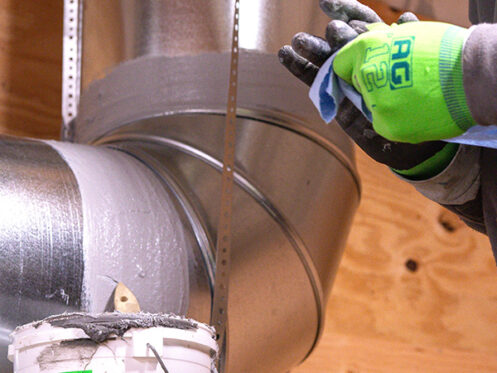
For exposed ductwork, the best option for resealing joints is to remove the old sealant and then apply the new product. Trying to reseal ductwork yourself with regular duct tape is never effective, as this isn’t what duct tape is designed for, despite its name.
There are other advanced methods that allow us to reseal hidden ductwork without needing to cut holes in drywall to gain access. The most common method is to seal up all the supply vents and then turn on the HVAC system to pressurize the ductwork. A technician then sprays a special aerosol polymer into the ductwork, which seals any holes and gaps from the inside. The fact that the ductwork is pressurized means that the aerosol will get pushed into any holes that exist. The polymer will stick to the sides of the hole to fully seal it up.
Contact the HVAC Pros for Help!
Pro Heating and Cooling, Inc. is a locally owned and operated company offering expert HVAC services to homeowners in Hillsboro and the Portland, OR Metro Area. We specialize in duct sealing and have innovative, non-invasive, and cost-effective solutions to meet your specific needs. We can also help if you need to have the ductwork in your attic or crawl space insulated, your ductwork replaced, or a ductwork system installed in a new home construction.
If you’re concerned about leaky ducts in your home, contact us at Pro Heating and Cooling, Inc. today for an evaluation.